SWELL Sculpture Festival, based in Currumbin on the Gold Coast, is a celebrated annual arts festival that reimagines the coastline as an open-air gallery. Each year, it brings together artists, audiences and communities through large-scale installations, exhibitions, performances and a dynamic year-round program, making art accessible across beaches, parks, galleries and public spaces.
For 24 years, SWELL Founder and Artistic Director Dr Natasha Edwards has championed the belief that public art can bring people together, enrich places and tell powerful stories. Today, she continues to guide the festival’s artistic direction with the support of a dynamic team, a committed Board and a broad community of artists, partners, volunteers and supporters.
Looking back to 2003, when SWELL began with just 23 sculptures and 6,000 visitors, could you ever have imagined it would evolve into the major cultural event it is today, with more than 80 sculptures and an audience exceeding 100,000 people?
My curatorial practice has always been grounded in the relationship between art, landscape and people. I have long been drawn to sculpture and public art, particularly work that responds to its setting and transforms the way we experience a place.
The ocean has also been a constant presence throughout my life. As an avid sailor, I understand its movement, changing light, energy and unpredictability. Looking back, my love of sculpture, public art, landscape and sailing came together in a very natural way, as though life gradually led me in this direction.
Deep down, I believed SWELL had the potential to become a significant large-scale exhibition, but growth was never the driver. The original purpose was simple: Getting Art Out There. I wanted to create an exhibition that connected artists and their work with the landscape that inspired them, while making art accessible to everyone.
In 2003, we began with 23 sculptures, around 6,000 visitors and an extraordinary coastal setting. At the time, the Gold Coast had limited spaces capable of presenting sculpture at the scale I imagined, so the coastline offered another possibility: the landscape itself could become the gallery.
What has evolved since then is the result of a shared vision. As Founder, I have been supported to continue guiding SWELL’s artistic direction by a dynamic team, each bringing their own expertise, ideas and energy, together with a committed Board providing strong governance and strategic support. Our artists, partners, volunteers and communities have also played an essential role in shaping the festival throughout its 24-year journey.
We are storytellers, and that is something SWELL does particularly well. Each year, the festival creates a moment in time when artists, audiences, landscape and community come together through a shared cultural experience.
At the centre of that experience are our artists. We celebrate the originality of their ideas, the depth of their skill and the determination required to bring an artwork from imagination into physical form. We also recognise the challenges they overcome—the experimentation, engineering, fabrication and problem-solving that may remain largely unseen by audiences.
There is an exhilarating energy in encountering something larger than ourselves. Public art gives us permission to be curious, to respond instinctively and to rediscover the creativity we often associate with childhood. SWELL creates a welcoming and supported environment where people can wonder, question, play and participate without needing specialist knowledge or being told what they should feel.
We are proud of the scale SWELL has reached, but the numbers are only one part of the story. What matters most is the experience we create together and the connections formed between artists, art, landscape and people.
What first inspired you to create SWELL? Was there a defining moment when the idea took shape?
It was not one dramatic defining moment, but rather a coming together of several deeply held ideas.
I have always loved the ocean, and my connection to the sea gave me an instinctive belief that sculpture and the coastal landscape could create a powerful experience together. The ocean is never static. The weather, light, wind and movement of people continually alter how an artwork is encountered.
Rather than thinking of the absence of a large conventional gallery as a limitation, I began to understand that the landscape itself could become the gallery.
The coastline, however, is never simply a backdrop for sculpture. Each work must enter into a meaningful relationship with its site, responding to scale, material, weather, movement, environmental conditions and the ways audiences experience the landscape.
Curating within the coastal environment also carries a responsibility to understand its ecological sensitivity, cultural histories and the many communities for whom the place holds meaning. That responsibility is part of the curatorial process and influences how works are selected, positioned and experienced.
I wanted to connect artists with a place that could challenge and inspire them, and to create an exhibition people could discover naturally while walking, swimming, surfing or spending time with their families.
I followed my instincts. I believed that if we presented compelling art within an extraordinary landscape and made the experience freely accessible, people would engage with it. That belief became SWELL.
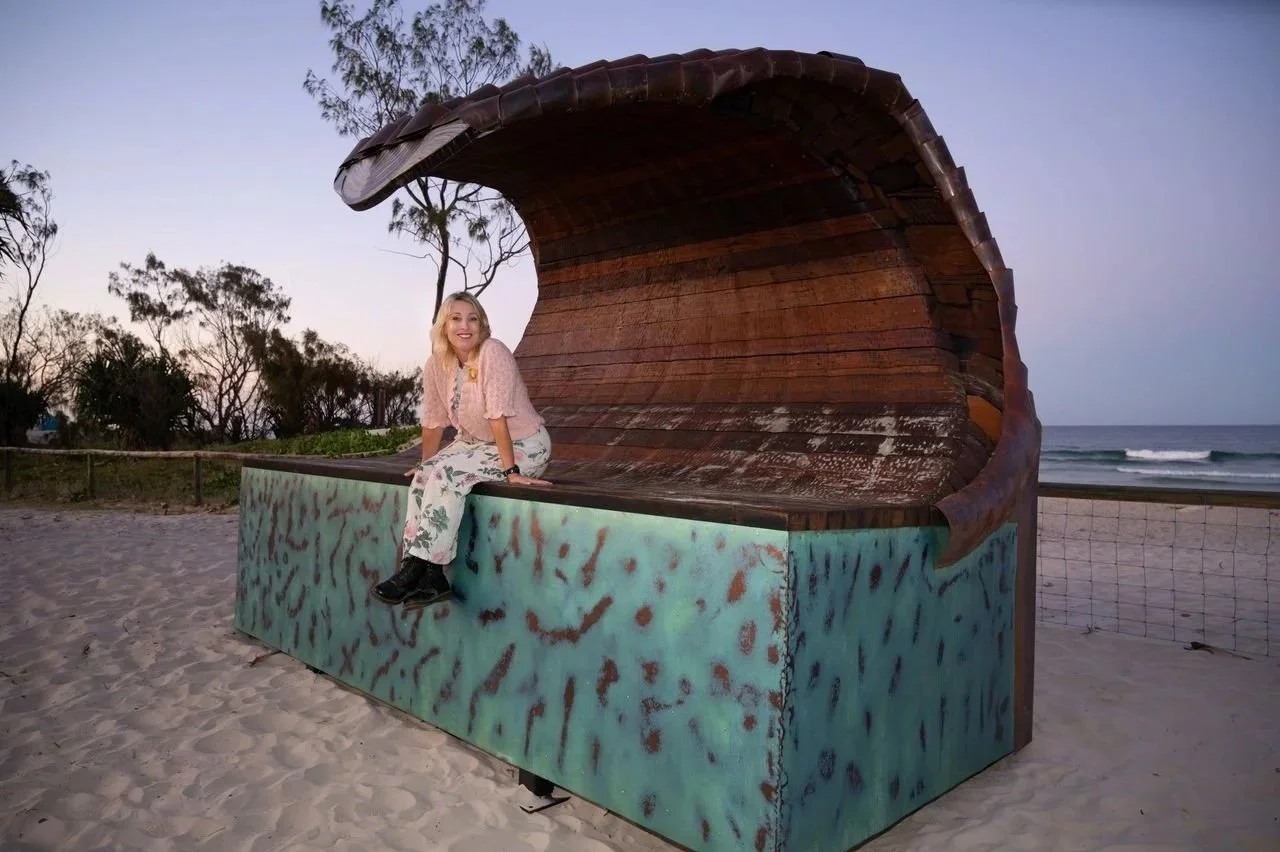
SWELL has become so much more than an exhibition. How would you describe its role in shaping the cultural identity of the Gold Coast?
SWELL has helped demonstrate that culture can belong within the everyday life of the Gold Coast.
Our beaches and coastal spaces are central to the identity of this city. By bringing sculpture into those landscapes, SWELL has added another layer to how people experience and understand the Gold Coast. The coastline becomes not only a place for recreation, but also a place for imagination, critical reflection, conversation and cultural expression.
The festival creates an open point of entry into contemporary art. Someone may arrive without intending to visit an exhibition, encounter a sculpture on the beach and suddenly become part of a cultural experience.
Accessibility, however, does not require art to be simplified. It means creating the conditions in which people can encounter ambitious ideas openly, bring their own experiences to them and feel confident participating in the conversation.
What distinguishes SWELL is the way it asks artists to work at scale and in direct dialogue with a living coastal environment, while remaining freely accessible to a broad public audience. It brings together curatorial rigour, artistic ambition, environmental awareness and public participation in a setting that is constantly changing.
Over the years, SWELL has also created opportunities for artists, encouraged cultural tourism and brought local, national and international creative practices into dialogue with the region.
I do not believe SWELL defines the Gold Coast’s cultural identity by itself, but it has contributed to a broader and increasingly confident cultural landscape. It demonstrates that rigorous and ambitious contemporary art can exist outside traditional institutions while remaining genuinely accessible to the public.
You’ve often spoken about connecting People, Art and Place. What does that philosophy mean to you personally?
For me, People, Art and Place are inseparable.
An artwork is never experienced in isolation. Its meaning is shaped by where it is situated, who encounters it and what conversations, memories or emotions it generates. In a public setting, the landscape becomes an active participant in the work, while audiences bring their own histories and interpretations.
Place is not neutral. It carries environmental, social and cultural meaning, and curating within it requires sensitivity, consultation and care. The most successful site-responsive works do not merely occupy a location; they create a meaningful exchange with it.
I am fascinated by what happens around an artwork: strangers beginning a conversation, children asking unexpected questions, an artist witnessing someone respond emotionally to their work, or a familiar landscape suddenly being seen differently.
Audiences are not passive spectators at SWELL. They move around the works, encounter them from changing perspectives, return at different times of day and contribute their own experiences to the meaning of the exhibition.
That is where public art becomes powerful. It creates a shared experience without requiring prior knowledge or prescribing a single correct response.
Personally, this philosophy reflects my belief that art should be generous, challenging and accessible. It should invite people in, stimulate curiosity and deepen our relationship with the places we share.
Supporting artists has always been central to SWELL. What has been one of your proudest moments watching an artist’s career flourish because of the festival?
It is difficult to identify only one moment because supporting artists has always been at the heart of SWELL.
Some of my proudest experiences have been watching artists present their first major outdoor work, build confidence through the process and then progress to further exhibitions, commissions, acquisitions and public art opportunities.
We have seen artists return to SWELL with increasingly ambitious ideas, more developed practices and a deeper understanding of how their work can respond to landscape and public space. It is enormously rewarding to witness that growth.
I am also proud when an artist makes a meaningful connection—with another artist, curator, collector, business, fabricator or community—that continues long after the festival has ended.
We would never claim responsibility for an artist’s career. Artists build those careers through enormous commitment, courage, discipline and hard work. Our responsibility is to create a professionally supported platform in which their work can be realised, encountered and understood.
That commitment now extends through our year-round work at M|Arts Precinct, professional development programs and emerging international opportunities. Artists need more than a place to exhibit. They need pathways that allow them to experiment, develop sustainable careers and extend their practice beyond geographic boundaries.
The long-term success of SWELL will always be measured partly by the opportunities it helps create for artists and by the confidence, knowledge and professional relationships they carry forward.
As a female founder and leader in the arts, what challenges have you faced, and how have they shaped your leadership style?
In the early years, one of the greatest challenges was convincing people that an ambitious outdoor sculpture exhibition could be artistically significant, operationally achievable and valuable to the wider community.
As a woman leading a project involving artistic direction, major infrastructure, machinery, engineering, public safety, government relationships and complex event delivery, there were certainly times when I felt I needed to demonstrate my capability before the vision itself would be taken seriously.
Those experiences strengthened my resilience, but they also shaped a leadership style that is collaborative, intuitive and highly prepared. I listen carefully, value different forms of expertise and believe strongly in giving people ownership of their contribution.
At the same time, leadership requires decisiveness. There are moments when you must trust your instincts, make difficult choices and remain focused on the artistic and organisational purpose.
I have learned not to dilute an idea simply because it is ambitious. I have also learned that leadership is not about having every answer yourself. It is about establishing a clear framework, bringing together the right people, creating trust and allowing a shared vision to become stronger through collective expertise.
The structure around SWELL is essential to its success. Our team brings specialist knowledge across artistic programming, production, artist services, partnerships, communications, safety and public engagement, while our Board provides governance, accountability and strategic guidance.
That collective strength allows the artistic vision to remain courageous while ensuring the organisation is responsible, sustainable and capable of delivering complex work in the public realm.
Receiving an Honorary Doctorate from Griffith University recognised your enormous contribution to arts and culture. What did that honour mean to you?
Receiving the honorary Doctor of the University from Griffith University was deeply humbling and incredibly meaningful.
My journey has not followed a conventional pathway. SWELL began with an idea, an instinct and a belief in what public art could contribute to the community. Over more than two decades, that belief has required persistence, constant learning and the support of many extraordinary people.
The honour felt like recognition not only of my own contribution, but also of the artists, Board members, team, volunteers, partners, supporters and communities who have helped build SWELL.
It was particularly significant because it acknowledged public art, curatorial practice and cultural leadership as important forms of civic contribution. It recognised that creating cultural opportunities, supporting artists and bringing people together through art can have a lasting impact on a region.
I accepted it with enormous gratitude and a strong sense of responsibility. For me, the title is not simply an acknowledgement of what has already been achieved. It is encouragement to continue advocating for artists, strengthening cultural infrastructure and creating opportunities for the next generation.
It also reinforced my belief that cultural leadership is not only about presenting finished outcomes. It is about building the relationships, structures and opportunities that allow creativity to develop and endure.
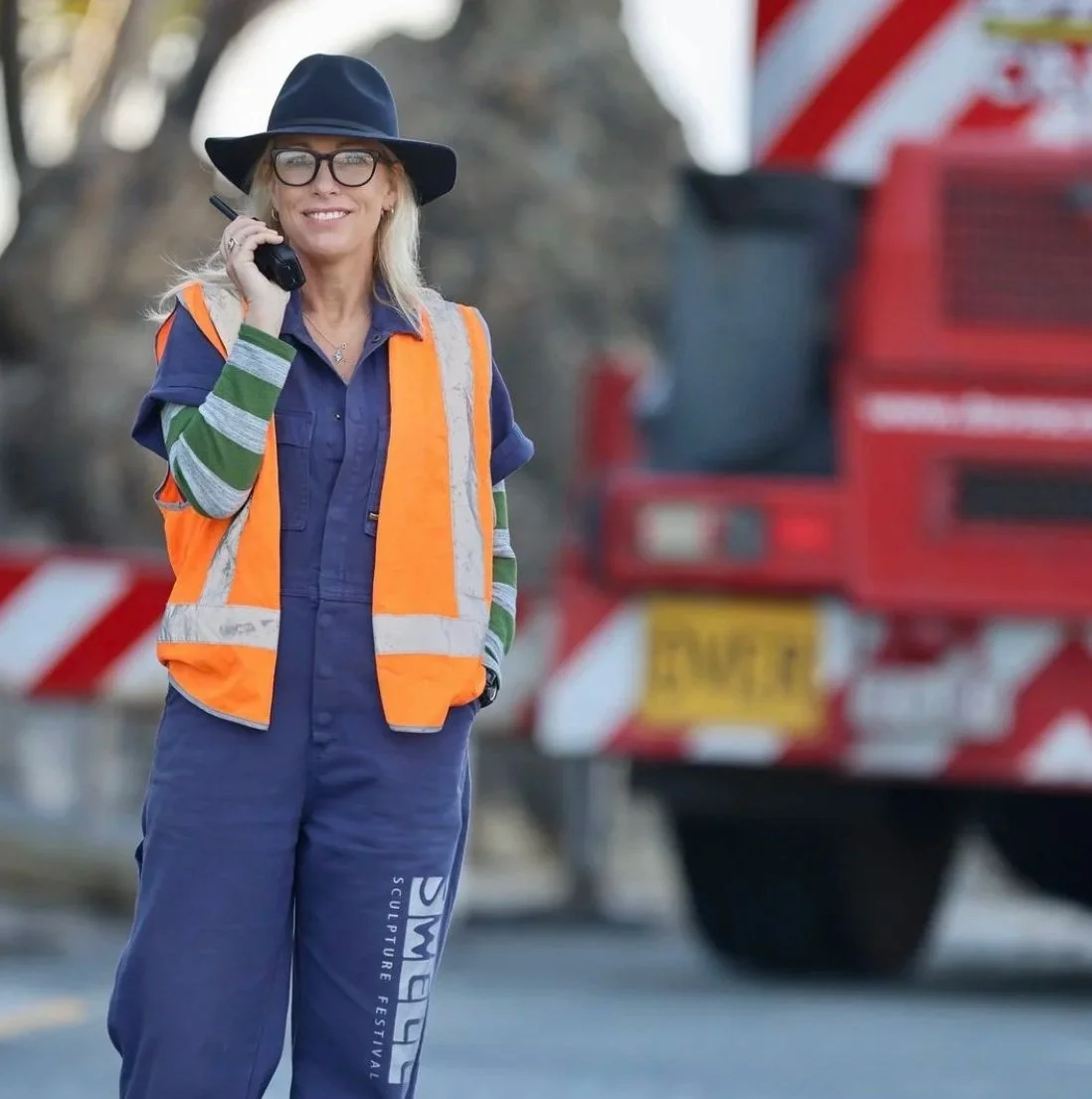
Tash on site at SWELL
Is there a sculpture, installation or exhibition over the years that has particularly stayed with you? Why?
It is almost impossible for me to choose one sculpture, because SWELL has never been about identifying a single favourite work. What stays with me is the experience created for the artists and the extraordinary collective creativity they bring to the landscape each year.
Without artists, there is no exhibition. Their ideas, courage, imagination and skill are the heart of SWELL. Creativity exists within all of us, and I believe it is something we must protect, nurture and hold onto. It is where dreams begin, but it is also grounded in discipline, technical knowledge and sustained effort.
Every sculpture represents far more than the finished object audiences encounter. It begins with an idea and develops through research, drawing, experimentation, material investigation, engineering, fabrication and countless hours of problem-solving.
The curatorial process continues through the careful positioning of the work and the practical challenge of securing a temporary sculpture within a changing coastal environment. We must balance artistic ambition with context, public safety, environmental conditions and ecological sensitivity while protecting the integrity of the artist’s intention.
The apparent openness and ease of the exhibition are supported by an enormous amount of curatorial, technical and operational consideration. From the relationship between individual works to the movement of audiences across the site, every decision contributes to the overall experience.
I am continually inspired by the generosity of the artists. They share knowledge, exchange ideas, help one another resolve challenges and learn through every stage of the SWELL experience. Established artists work alongside emerging artists, and those conversations often continue well beyond the exhibition.
What stays with me most is watching an artist stand back and see their work within the landscape for the first time, and then witnessing the public connect with something that may have existed only in that artist’s imagination months or even years earlier.
That is the success of the experience for me: creating a place where artists feel supported, challenged and valued, where creativity is shared openly, and where the artwork, landscape and audience come together to create something none of us could achieve alone.
How has the Gold Coast changed culturally since SWELL first began?
The Gold Coast has developed a much stronger and more confident cultural identity.
When SWELL began, the city was already known internationally for its coastline, lifestyle and tourism, but its cultural landscape was still emerging. Over the past two decades, there has been growing recognition that arts and culture are essential to the identity, liveability and future of the city.
We now see greater investment in cultural institutions, public art, festivals, creative industries and opportunities for artists. Audiences have also become increasingly curious and willing to engage with contemporary ideas in public spaces.
There is a greater understanding that culture does not compete with the Gold Coast lifestyle—it enriches and complicates it. Art can respond to our beaches, environment, histories, communities and changing urban landscape while creating experiences that are distinctive to this place.
SWELL has grown alongside that cultural transformation and is proud to have contributed to it. The festival has demonstrated that audiences will engage with ambitious contemporary art when it is presented with integrity, care and a meaningful relationship to place.
It has also shown that major cultural experiences do not need to be separated from everyday life. They can happen along a coastal path, within a park or in a place people already feel a strong personal connection to.
The Gold Coast is no longer simply asking whether culture belongs here. It is increasingly asking what kind of cultural city it wants to become and what lasting creative legacy it wants to build.
Looking ahead, what is your vision for the next decade of SWELL?
My vision is not simply for SWELL to become bigger. It is for its impact to become deeper, more sustainable and more far-reaching.
The annual coastal exhibition will always remain at the heart of SWELL. It is where the original vision of Getting Art Out There comes to life and where people, art and place connect in such a distinctive way.
Its temporary nature is also part of its power. For a defined moment, the coastline is transformed. The sculptures arrive, the landscape and audiences respond to them, and then the works disappear, leaving memories, conversations and new ways of seeing the place behind.
Around the annual exhibition, I see enormous potential to strengthen year-round opportunities for artists through exhibitions, residencies, education, masterclasses, mentoring, commissions and international exchange.
Our growing work at M|Arts Precinct and developing relationship with the Avalon Arts Precinct Artist in Residence program in Berlin are important parts of that future. I want SWELL to continue creating pathways that enable artists to experiment, develop sustainable careers and connect with audiences beyond geographic boundaries.
Strong partnerships will be essential to achieving that vision. Support from businesses, government, philanthropic organisations and community partners allows us to maintain free public access while investing directly in artists, education, accessibility, professional development and the safe delivery of ambitious work in the public realm.
For our partners, that means becoming part of something larger than a single event. It is an opportunity to contribute to artist development, community participation, cultural tourism and the long-term creative identity of the region.
As we move towards Brisbane 2032, there is an extraordinary opportunity to consider the cultural legacy we want to create across South East Queensland. Public art should be part of that legacy—not as decoration, but as essential cultural infrastructure.
Most importantly, I want SWELL to retain its generosity, accessibility, curatorial integrity and sense of discovery. Its future should remain grounded in artists, community and landscape while continuing to be courageous enough to imagine what comes next.